The World Remembers What Power Allows It To
Imperialists leave ruin in their wake. They didn’t win by virtue. They won by deception. By systems so calculated and manipulative that those on the receiving end were never meant to understand, let alone resist. And when the killing was done, they built one more system: a machinery of selective memory designed to ensure the world would only ever mourn the victims they chose.
The same civilization that gave the world Schindler’s List gave Africa the Herero genocide, and only one of those facts has a film budget behind it.
Germany did it in Namibia. Britain did it in Kenya. France did it in Algeria. Belgium did it in the Congo. The names change. The method doesn’t.
The Pattern Has a Name
In Kenya, the British detained and tortured over 150,000 Mau Mau suspects during the 1950s,a campaign so brutal that the UK government quietly paid £19.9 million in compensation in 2013, only after classified files were proven to have been deliberately destroyed. In Algeria, France killed an estimated 1.5 million people between 1954 and 1962, a figure France refused to formally acknowledge as colonial violence for decades. In the Congo, Belgium’s extraction regime under Leopold II killed an estimated 10 million people, yet Leopold died in his palace, his statues standing in Belgian cities until protesters tore them down in 2020.
Africa wears the proof. Genocide after genocide has been committed on its soil, met with a silence so total it can only be deliberate.
The Blueprint Europe Borrowed
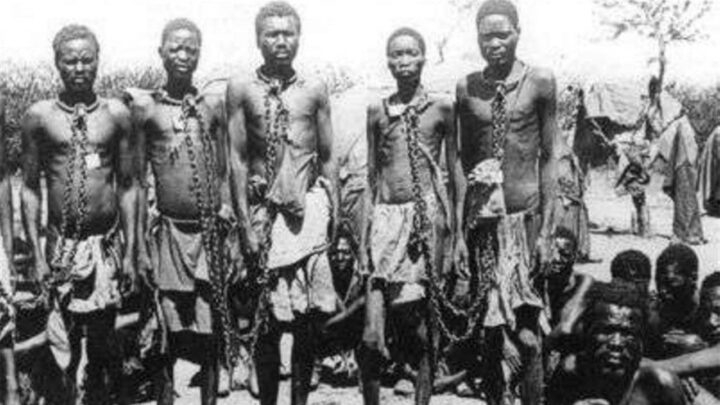
Consider the Herero and the Nama. In the 1900s, German colonizers faced resistance in Namibia and responded by systematically annihilating the Herero and Nama people when they dared to defend their homeland. Tens of thousands of men, women, and children were starved, hanged, shot, flogged, or worked to death as slave laborers in brutal concentration camps. By the time it was over, more than 80% of the Herero population and 50% of the Nama population had been annihilated. It was the world’s first genocide of the 20th century, the very blueprint for the atrocities that would later shock Europe.
Why One Is Remembered and One Is Not
Ask any student across the globe about the Herero and Nama, and you will get a blank stare. But mention the Holocaust, and recognition is instant. Hitler’s crimes are rightly etched into global memory; the world should never forget them. But both were horrific genocides, and only one is universally recognized. The problem is not that the Holocaust is remembered too well. The problem is that African blood, spilled by the exact same empire, has been deliberately erased.
Some argue this is simply a matter of documentation and proximity: the Holocaust occurred in Europe, was recorded by European institutions, and its survivors lived within reach of Western media. This explanation sounds reasonable. But it collapses under scrutiny. The Herero genocide was thoroughly documented; German military officers kept meticulous records, von Trotha’s extermination order survives in German archives, and colonial-era newspapers reported on it at the time. The story was not lost. It was buried. Herero oral traditions, community memory, and the Ovaherero Traditional Authority have preserved this history continuously for over a century, not because the world listened, but in spite of the fact that it didn’t.
Who Owns the Story
A handful of interconnected corporations, Disney, Comcast/NBCUniversal, Warner Bros. Discovery, Paramount Global, and News Corp, controlling not just studios and screens, but the banks that fund them and the governments that protect them, decide which wars get covered and which genocides get forgotten. Western studios, controlling the dominant share of global film, television, and publishing, have produced hundreds of movies memorializing the Holocaust, World War II, and every war in which the West cast itself as the moral hero, while producing virtually nothing about the genocides they themselves committed in Africa. The camera points where power tells it to, and power has never had an incentive to point it at Namibia, Kenya, the Congo, or Algeria. The result is a world where millions can name Auschwitz and cannot name the Kalahari Desert, where von Trotha’s extermination order sits in a German archive and not in a single mainstream film.
IMDB lists over 500 films dealing with the Holocaust. Schindler’s List, The Pianist, Life Is Beautiful, Sophie’s Choice, produced with open budgets, distributed globally, taught in schools, and awarded the industry’s highest honors. No studio will pour that same money into the Herero genocide. No distributor will champion it.
But this media consolidation did not emerge from nowhere. The same colonial-era wealth, extracted from Namibian land, Congolese rubber, and Kenyan labor, was reinvested into the financial institutions that seeded modern media empires. The Bank of England, Lloyd’s of London, and major European investment houses all carried colonial capital into the industrial age. What looks like cultural indifference in a Hollywood boardroom today is the downstream consequence of an economic system built on colonial extraction.
Germany’s Double Standard
The contrast becomes most damning when you look at Germany itself. Germany has built museums, memorials, and mandatory school curricula around the Holocaust, an acknowledgment the world rightly praises. Yet when it comes to the Herero and Nama, the same Germany took over a century to offer even a partial response. In 2021, Germany handed Namibia €1.1 billion and called it “reconciliation funding,” a label chosen with surgical precision to ensure the word reparations never appeared, and legal liability never followed. Herero and Nama leaders rejected it. They were not consulted in the negotiations that were supposed to be about them.
When the criteria for acknowledgment shifts based on the race of the victims and the legal exposure of the perpetrator, the message is clear: some lives earned a memorial. Others warranted a memo.
Kill the Memory, Then Kill the Man
This erasure is not merely historical; it serves present interests. Keeping colonial crimes out of global consciousness protects the reputations of nations still benefiting from the wealth extracted during that era. Reparations, accountability, and restructured global power all become easier to avoid when the crime itself is kept invisible. And when African nations dared to elect leaders who put their own people first, Patrice Lumumba in the Congo, Thomas Sankara in Burkina Faso, Kwame Nkrumah in Ghana, the CIA and Western intelligence agencies engineered coups and simply assassinated them. Lumumba was assassinated on January 17, 1961, in a plot that declassified CIA cables and a U.S. Senate Church Committee investigation confirmed involved American intelligence and Belgian operatives. Sankara, who launched mass literacy campaigns and rejected IMF debt as a new form of colonialism, was shot dead in 1987 in a coup widely linked to French intelligence.
You cannot demand reparations from a country if you do not know the crime was committed. And you cannot build an independent African future if the leaders who attempt it keep ending up dead.
Africa Is Not Waiting
But Africa is done waiting to be remembered. Brilliant African scholars have spent decades forcing these histories into academic light. Pan-African movements, diaspora activists, and Herero descendants themselves, like the Ovaherero Traditional Authority, have refused to let this genocide disappear into diplomatic silence. A pan-African consciousness is rising, bound together by a fierce identity that refuses to be erased.
And this time, Africa will not wait for someone else to tell its story; it will tell it itself, on its own terms, to the entire world.
The Silence Is a Decision
Every person who consumes history only as it is served to them is participating in the erasure. Break the trance. Seek out the historians your curriculum never assigned. Read the history. Say the names. Teach your children what the school doesn’t. The machinery of erasure only holds as long as the silence does, and silence, in the end, is always a decision.
Start here:
- Read: How Europe Underdeveloped Africa by Walter Rodney; The Wretched of the Earth by Frantz Fanon; Decolonising the Mind by Ngũgĩ wa Thiong’o; The African Origin of Civilization by Cheikh Anta Diop
- Watch: Lumumba (2000, dir. Raoul Peck); Namibia: The Struggle for Liberation (2007)
- Support: The Ovaherero Traditional Authority’s ongoing reparations campaign
Say the names. Maharero Tjamuaha. Samuel Maharero. Hendrik Witbooi. They are not footnotes. They are the story.

